
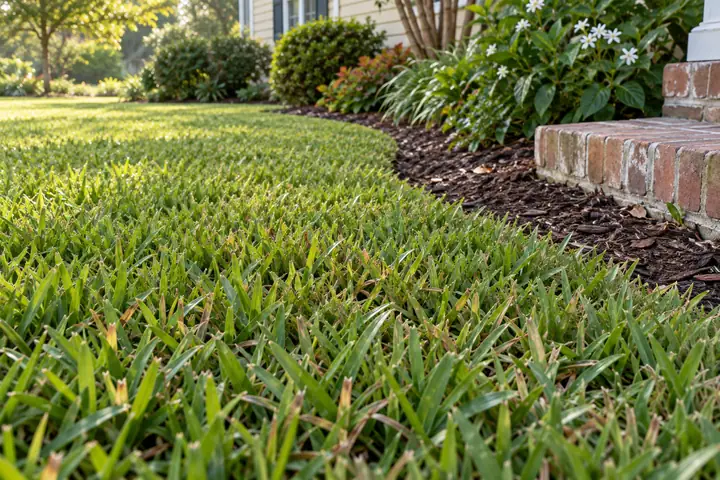
Start with the blade, then step back
A lawn can look brown from the porch for several different reasons. Gray leaf spot is one reason to get closer to the leaves instead of deciding from the outline of the discolored area. LSU AgCenter describes a foliage disease that commonly affects St. Augustinegrass in Louisiana. Its early marks are small brown lesions that can enlarge into pale-centered spots with darker borders. That description gives you something specific to report; it does not turn every spotted blade into a confirmed diagnosis.
Begin with a question you can actually answer: is the discoloration inside individual blades, across their cut ends, or spread over entire plants? Look at several leaves without stripping a patch bare. A single damaged leaf beside a whole yard of healthy growth deserves a different conversation from similar marks appearing throughout a thinning section. Keep those two scales together. The leaf tells part of the story; the distribution tells another part. Neither needs an impressive disease name to be useful.
What a lesion description can and cannot tell you
University of Georgia Extension describes mature gray leaf spot lesions as elongated or oval, sometimes with a depressed gray or tan center and an irregular darker margin. Wet, warm conditions may allow a gray, fuzzy appearance in a lesion. Those are features to compare with an Extension reference, not features to manufacture by wetting leaves or waiting for a particular color. A phone image can lose the border entirely, especially when sunlight reflects off a damp blade.
Describe what you see before interpreting it. “Several broad blades have separate tan marks inside otherwise green tissue” is more useful than “the fungus is everywhere.” If the marks are only at ragged cut tips, say that instead. Include whether leaves remain upright, have withered, or are mixed with apparently normal leaves. Do not remove every marked leaf to make the lawn look better before seeking advice. That can leave the next reviewer with a different set of evidence from the one that concerned you.
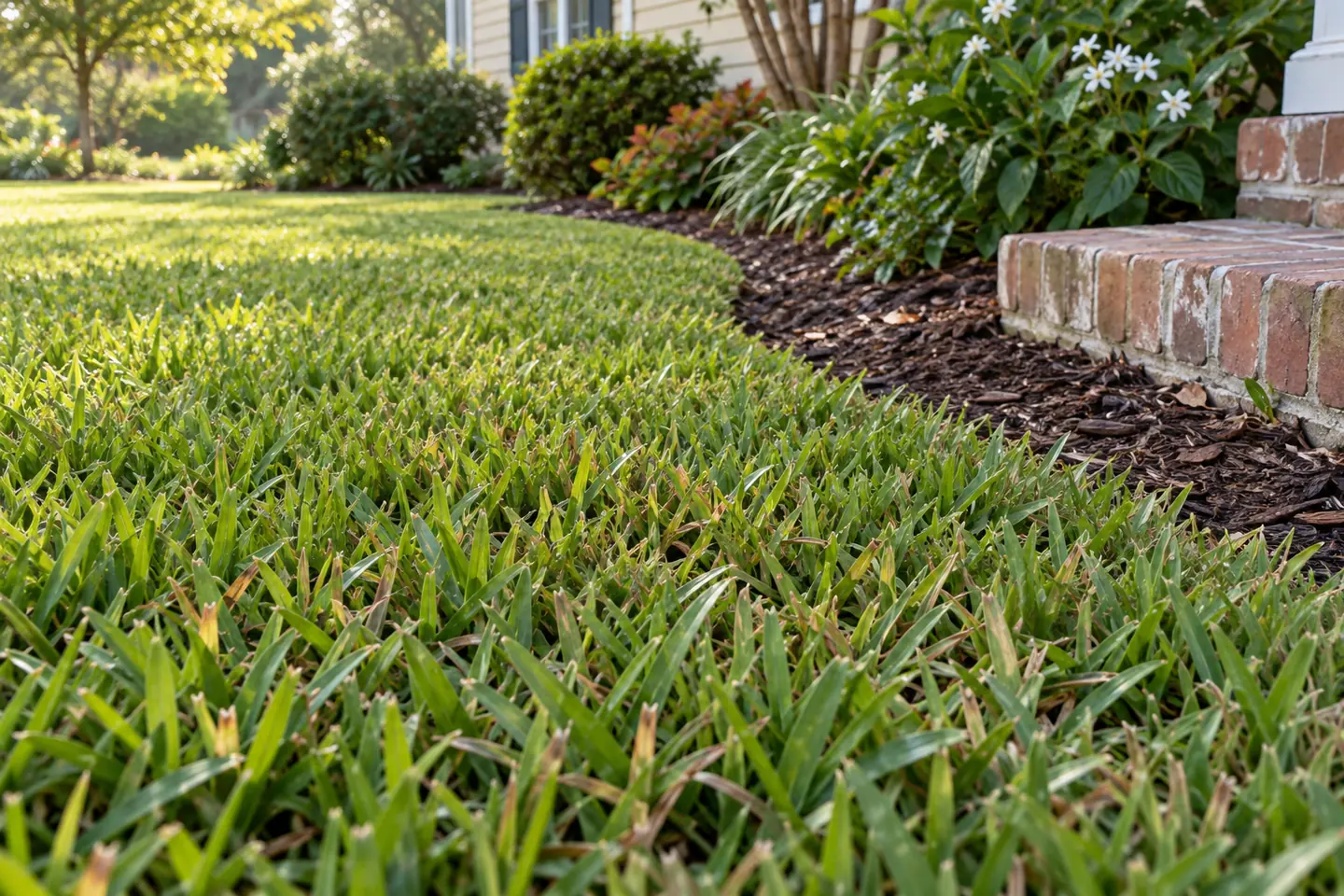
A brown cast does not require a neat circle
NC State Extension explains that gray leaf spot in St. Augustinegrass need not form distinct patches. Injured leaves can instead give the stand an overall brown appearance. This matters when an internet search offers nothing but tidy circles. A disease guide illustrated with a different grass is not a pattern template for your yard. Start with the grass actually present, then consider which part of the plant is affected.
Try dividing your observations into three zones: the place that first caught your attention, the transition beside it, and a comparison area that still looks normal. You are not assigning a diagnosis to each zone. You are checking whether the same blade marks occur in all three and whether the density changes between them. A leaf problem spread through the canopy and a sharply bounded loss of whole plants raise different questions. If your description does not fit a named guide comfortably, keep the uncertainty in the report.
Separate leaf wetness from water in the ground
Gray leaf spot guidance repeatedly emphasizes extended wetness on foliage. That is a different observation from a puddle or soil that feels damp. A yard can receive rain, irrigation and morning dew during the same period, so “we only watered once” does not describe every wetting event. Note when the blades are wet and when they become dry enough to handle without soaking your fingers. You do not need to invent an exact hourly record after the fact.
A useful sketch can show the sunny front section, a bed edge that stays shaded, and the place where a sprinkler overlaps the walkway. Mark observed differences rather than assuming one feature caused the symptoms. For example, “leaves beside the hedge were still wet when the open lawn was dry” describes a comparison. “The hedge caused the disease” goes beyond it. This distinction helps a qualified reviewer ask better follow-up questions without sending you straight into changes to trees, drainage or irrigation equipment.
Review summer inputs without treating color as a fertilizer test
LSU lists high nitrogen fertility and several forms of turf stress among conditions associated with gray leaf spot development. That is a reason to retain the history of recent lawn inputs, not a reason to diagnose nutrition from a brown patch. If someone has applied a lawn product, keep the name, approximate date and actual area treated. If you do not know what was used, record that gap rather than selecting the most familiar product name.
An application history should distinguish the front from the back and a spot treatment from a whole-lawn treatment. Include work performed by anyone maintaining the property, not just the current mowing provider. The point is to give the person assessing the leaves an honest sequence. Do not add a new product merely to see whether the symptoms respond. Changing several inputs at once can make the next discussion harder, particularly when the original condition was never identified. Nutrition and treatment recommendations belong with an appropriate assessment of the actual grass and site.
Keep mowing decisions tied to the living canopy
The practical mowing question is how to maintain the grass that remains while a leaf problem is being reviewed. It is not how to cut low enough to erase every blemish. UGA and NC State both discuss correct mowing for the turf species and management of clippings when gray leaf spot is evident. LSU also advises avoiding wet mowing and considering the order in which affected areas are cut. Confirm how those recommendations apply to your assessment before the next visit.
Tell the crew which area is under review and whether an adviser has supplied a specific mowing instruction. “Please look at the back-left bed edge before starting” is actionable. “Fix the fungus while you are here” bundles diagnosis, treatment and maintenance into one request. If clipping collection or a different sequence is being considered, discuss it in advance; neither is automatically part of an existing visit. The crew needs to know the change before mowing removes the foliage you intended to show.
Use a leaf-focused comparison record
For this particular concern, a useful record pairs an overall view with a clear blade-level view. Keep the camera focused on the marked tissue rather than on a distant lawn behind it. Place the leaf against a plain background if that helps, without altering its color or drawing a guessed lesion outline. Retain the original image. A heavily sharpened or filtered version can make natural texture look like a border that was never visible in person.
For a follow-up, compare the same kind of evidence: new marked leaves, the amount of living foliage, and the extent of thinning. A freshly cut lawn may look more uniformly green simply because some affected tissue has been removed. That appearance does not establish that the underlying problem has ended. Likewise, old discolored leaves can remain visible while new foliage changes the overall picture. Keep “looks tidier,” “has fewer marked leaves,” and “has been assessed as improving” as three separate statements.
Know when the next step is identification
If symptoms are increasing, the turf identity is uncertain, or several explanations remain plausible, seek guidance from an appropriate Extension or plant diagnostic resource. Ask what material and history they want before removing a sample. An adviser may need more than detached leaves, and a specimen prepared for one purpose may be unhelpful for another. Follow the receiving service's current directions rather than assuming that a bag of dry clippings is a complete sample.
Make the question narrow enough to answer. Ask whether the observed leaf marks are consistent with gray leaf spot, what competing explanations should be considered, and what would change the maintenance plan. If a treatment is recommended, ask who is providing it and how mowing should fit around that work. A written handoff prevents a useful diagnosis from being reduced to a vague instruction to “do something about the brown.” It also gives the next review a clear reference point.
Put the observation into a sensible yard plan
A short working note can bring the evidence together: the grass identification if known, the first noticed date, the distribution of blade marks, recent water and product history, and the specific question awaiting review. Leave space for an answer and the date it was supplied. This is not a certificate of lawn health. It is a way to keep a changing leaf problem from turning into a series of conflicting guesses.
For a West Bank yard in Harvey, Marrero, Gretna, Algiers, Belle Chasse or Westwego, that clarity helps the maintenance conversation stay useful. The lawn can need a thoughtful cut and a separate assessment at the same time. Keep the two appointments connected through actual instructions, then revisit the plan when the evidence changes. A friendly lawn visit should leave you with fewer questions about the agreed work, even when the leaves still need an expert answer.
Talk with Happy about the maintenance scope
Happy Grass focuses on the lawn-maintenance work confirmed in your quote. Call 504-339-3571 and ask for Happy. Educational information about gray leaf spot does not add diagnosis, fungicide treatment, fertilization, aeration, overseeding or pest control to a mowing agreement. Share any assessment instructions before arranging the visit.